What is local SEO?
In short, local SEO is about optimising your online presence to attract customers from specific geographic areas. Unlike traditional SEO, which targets broad (potentially global) audiences, local SEO concentrates on appearing in search results when potential customers look for products or services which are either "near them" or in specific locations.
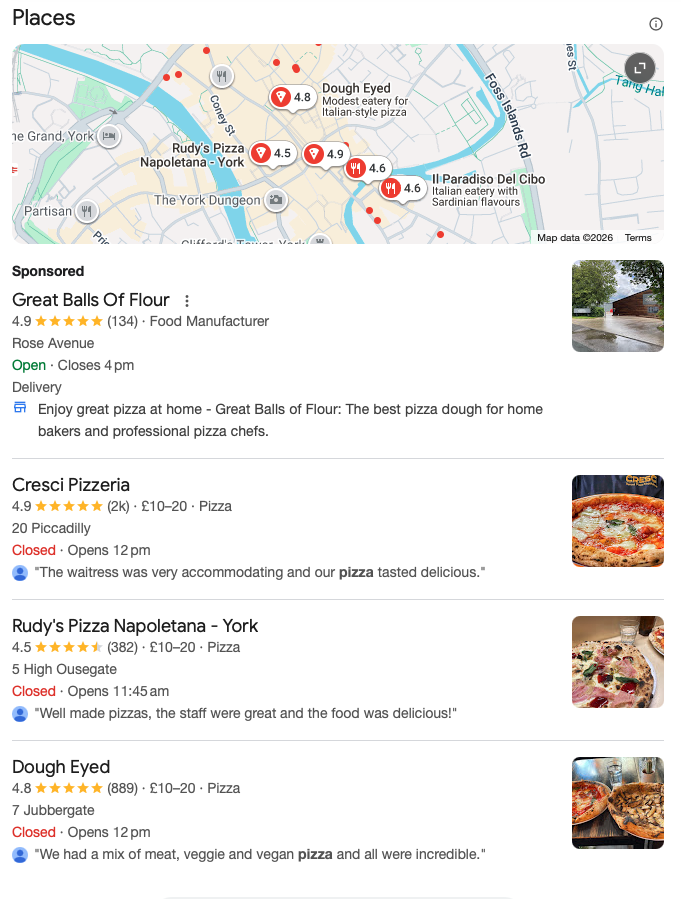
As an example, see below - searching for "pizza in York" returns the following results (note, this is in the main search results, before the matching web pages are even shown, not on the map page) - ignoring the first, which is a sponsored result, the remainder are all chosen based on their local SEO rankings.
Why is it important?
The importance lies in reaching the people who are looking for your services, in your area, at the time at which they are looking - these sorts of potential customers have high commercial intent and are generally ready to buy your products / services, there and then. In marketing times, they're gold dust.
As a result of this intent, you will find that they convert from visitors into buyers at a much higher rate than normal web traffic.
Since it's often neglected, particularly by small and medium-sized businesses, it's easy to get a commercial edge over your competitors - and it's one of those things that continues to deliver without being tied to an ongoing advertising spend.
How best to implement it?
The starting point is your Google Business Profile (it used to be called Google My Business). If you haven't claimed your business, do so - the verification process is more complicated than it used to be, but once it's done, it's done.
Complete every section - business name, address, phone number, hours, categories, description, and so on. Throw the kitchen sink in, but be sure to choose your categories wisely.
Add high quality images - interior and exterior, team, and product photos (if relevant) - as profiles with photos get 40%+ more requests for directions and 35%+ more clicks through to their websites.
If you can, post regular updates. Events, updates, news, offers - posts keep your profile fresh, and relevant and signal active management.
Once the reviews start coming in be sure to respond to all of them - positive or negative - within 24-48 hours - as your response rate affects your rankings.
Other locations & consistency
Although to a lesser extent, Bing Places, Apple Maps and Yelp still have their place in your local SEO strategy, so once your Google Business Profile is up and running, focus on those too.
Be sure to be consistent in naming (if you're on Acacia Avenue, use Avenue throughout, rather than abbreviating to Av. in some places). If you spy duplicate listings, claim or merge them to clear them up.
On your website
One of our previous posts in this series looked at Rich Results / Schema markup, and at the very least you should be employing the LocalBusiness / Organization markup to full effect, using it as another route to give the search engines details of your locations, hours, services and the like.
.If you have multiple locations, ensure that you have one page for each location, including a Google Map to reinforce the geographic nature. Whilst, out-of-the-box, Google Maps can be a bit jarring, with some custom styling it's possible to fit them into your site's design scheme much more smoothly.
Review strategy
Whilst reviews are very important part of local SEO, there's a few key criteria to respect. Firstly, ask for reviews at the right time - ideally immediately after positive experiences when customer satisfaction is highest. Make it as easy as possible - send customers direct links to your profiles. If you're on multiple sites, diversify your reviews across them for a broad reach.
And, for goodness sake, never use fake reviews. Google will pick them up and your profile will be suspended.
Mobile optimisation
You're primarily targeting users on their mobile phones, so your site has to cater to them perfectly. The next post in this series is all about that, so be sure to check back in on it on Friday 23rd January.
How to track results?
Your Google Business Profile will give you insights which you should look over monthly - these will include search queries that trigger your listing being shown, how many times your listing is viewed, how many actions were taken on your listing (website clicks, phone number clicks, requests for directions, etc.), and a comparison of how you stack up against your competitors.
Within Google Analytics (which we covered in more detail in a previous post in this series) you can view data on the geographic locations of your visitors, filter traffic that is generated from organic local searches, and compare how that performs against your overall website traffic. If you set up custom landing pages for specific issues, you can view how those are performing as well.
In summary
You should treat local SEO as an ongoing process. Consistency in optimization, review generation, staying updated - it will all pay dividends over time, and those businesses which commit to local SEO typically see measurable results within 3-6 months, with compounding benefits as their authority grows.
The businesses that dominate local search are those that treat their online presence with the same care they give their physical location. Start with the fundamentals and buid from there, always being sure to track your progress and performance. Your competitors are likely neglecting these strategies, giving you a significant opportunity to capture market share in your area.
We're always happy to have a no obligation chat about anything that we've covered here if you would like more information, so feel free to get in touch with us if you would like more guidance.
Missed the previous post? Catch up with Day 7: Google Search Console.
Next, we look at your site on mobile in Day 9 of our 10 Days to a Healthier Website series.
For a deeper dive into Schema markup and local SEO, see our post on How Schema Markup Improves Local SEO Performance.